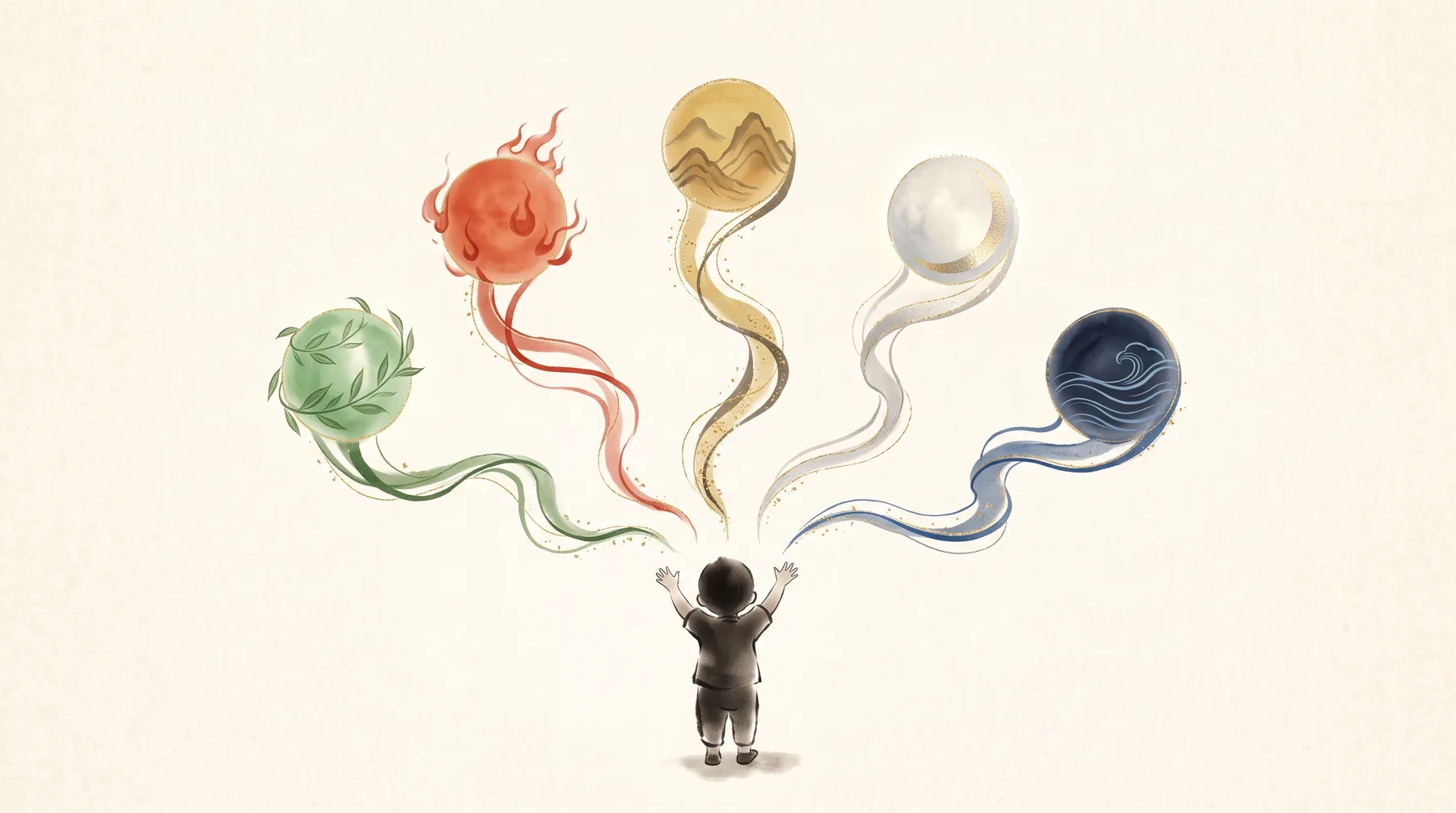
A thousand-year-old way of seeing a child clearly
The Four Pillars calendar records the elemental balance of the exact moment your child arrived — and reads it as a map of temperament, learning style and timing. Six short chapters cover everything the dashboard is doing.
The Four Pillars
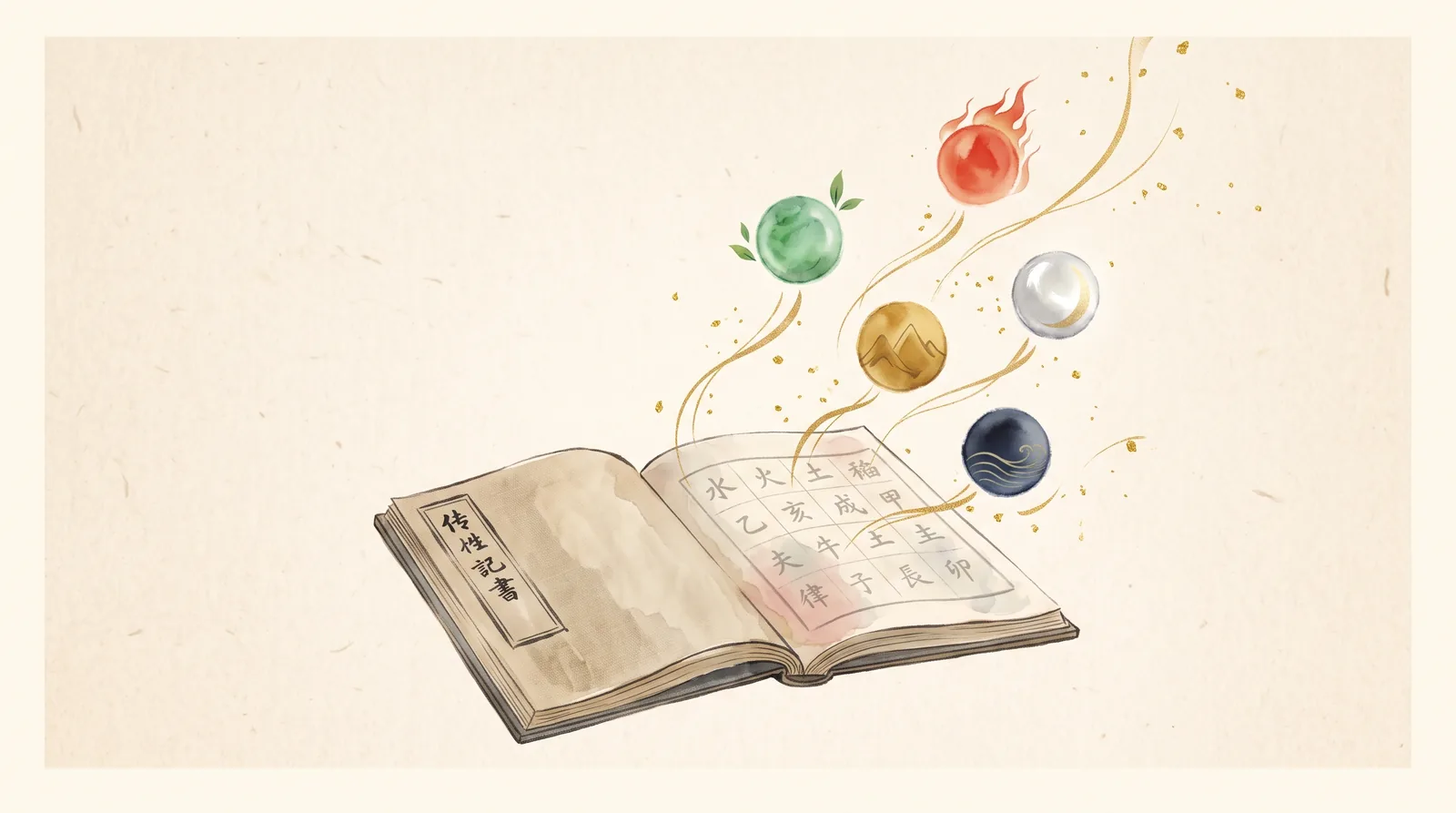
A birth moment written as four two-character pillars — year, month, day and hour. Eight characters in total: the 八字.
grandparents, heritage, the world the child is born into
parents, daily environment — the strongest seasonal influence on the chart
the Day Master — who your child actually is at the core
inner life, aspirations, how they recharge when no one is watching
Each pillar has a stem (top character — a pure element, like 丙 yang Fire) and a branch (bottom character — a zodiac animal hour/month/year that hides one to three more elements inside). That's why two children born in the same year can be so different: the year is only one pillar of four. If the birth time isn't known, the dashboard builds an exact three-pillar chart — personality, talents and the roadmap all stay readable.
The Five Elements
Every character in the chart is one of five elements — and the elements are always in motion.
The elements don't just sit there — they move.
Every element feeds one and restrains another. This constant motion is what the Elemental Radar and Study Climate on your child's dashboard are actually reading.
Generating 相生: Wood feeds Fire, Fire feeds Earth, Earth feeds Metal, Metal feeds Water, Water feeds Wood — where strengths come from.
Controlling 相克: each element also restrains another — where blindspots and headwinds come from.
In a child's chart the five elements map to five everyday currents: Wood growth & drive, Fire joy & expression, Earth stability & trust, Metal focus & standards, Water wisdom & imagination. No shape is wrong — the shape is the personality.
Ten natures. Which one is your child?
The day stem — the Day Master — is the core of the whole reading. Ten stems, ten archetypes.
Every chart centers on one of ten Day Masters — tap any of them to find your child's.
Strength & the favorable element
Why a chart full of Fire can still need more Fire.
The dashboard doesn't just count elements — it weighs the Day Master against the season of birth, the way classical practitioners do. When the supporting currents (Resources 印 and Companions 比劫) carry half or more of the chart's weight, the Day Master is strong and thrives on expression, achievement and challenge. When they carry less, the Day Master is gently held and is best fed by support, learning and peers — sometimes by more of its own element, even if that element already looks plentiful on the radar. That's why the favorable element can differ from the biggest slice of the wheel: the season outweighs the count.
On the dashboard, the favorable element powers the Motivation Key on the roadmap — the carrot that actually works, the stick to retire, and the environment that keeps your child topped up.
The moving pillars
The natal chart is the instrument. The moving pillars are the weather it plays in.
A ten-year pillar that colours a whole phase of childhood. Its start age and direction come from the birth chart itself.
Each year brings its own pillar — a study year, a teamwork year, a discipline year. The Study Climate card reads it for you.
The fine grain: when to push, when to consolidate, when to protect rest. Updates monthly on the dashboard.
The Hidden Dynamics card goes one layer deeper: it watches how these moving pillars combine or clash with the natal eight characters (合冲刑害) — the classical way of spotting a restless season or a golden window before it arrives.
Raising by design
The chart never excuses behaviour — it explains energy. Here's how to actually use it, day to day.
Motivate in their currency. A Wood-favorable child runs on visible growth and bigger responsibility; a Fire child on audience and celebration; an Earth child on trust and routine; a Metal child on standards met; a Water child on curiosity honoured. Most parenting friction is paying a child in the wrong currency.
Match the learning engine, not the trend. A structured learner needs worked examples and a teacher they respect before creative freedom; an exploratory learner needs the "why" before the "what". The gauge on the dashboard tells you which enrolment question to ask first.
Feed the signature, schedule around the friction. Formations (三合 · 三会) are talent currents — give them a weekly outlet. Clashes and punishments (冲 · 刑) are recurring rubs, not flaws — predictable routines and early transition warnings turn them into resilience.
Parent each child differently — on purpose. Siblings share a home, not a chart. The Compare and Family Chemistry pages exist so "one rulebook for both" can retire gracefully — and so you can see the role your own energy plays in each child's chart.
Read the season, then relax. An absorption year is for foundations; a teamwork year for study groups; a discipline month for exam prep. Work with the calendar instead of against it — and remember the chart describes tendencies, never limits. More chapters on child management are on the way.